

Lot n° 185
Estimation :
15000 - 20000
EUR
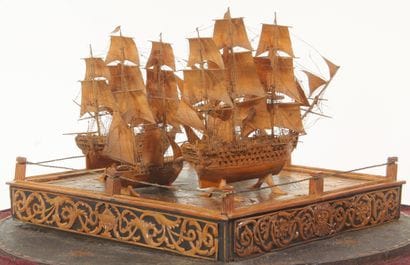
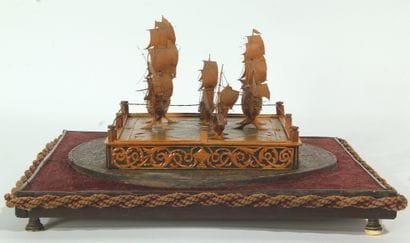
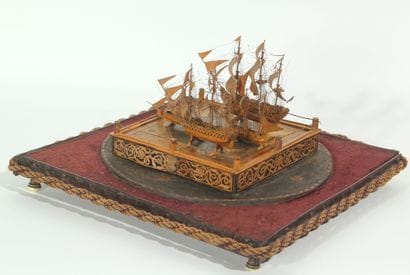
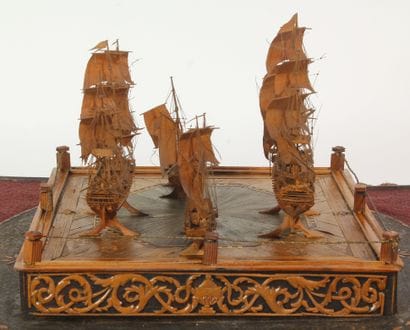
A composition of four boxwood pontoon models, all presented - Lot 185
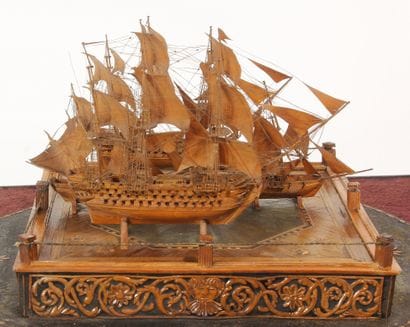
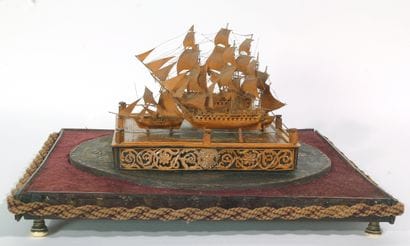
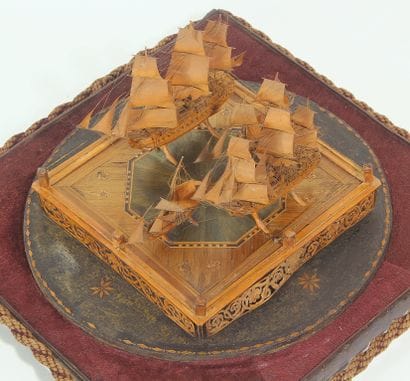
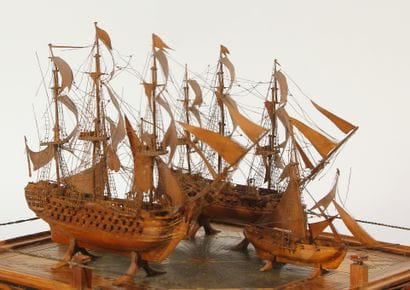
A composition of four boxwood pontoon models, all presented with sails and guns in combat position. It groups together the four types of ship of which all the world's navies were composed at the very beginning of the 19th century.
1) A ship of the line
2) War frigate
3) War lugger
4) War cutter.
All models are to the same scale, so that the proportions of each can be appreciated by comparison. Although very small, they are nonetheless lacking in finesse, detail and realism.
The largest, for the ship, measures 11.5 cm, including the bowsprit, while the smallest, for the cutter, measures 6 cm, including the bowsprit.
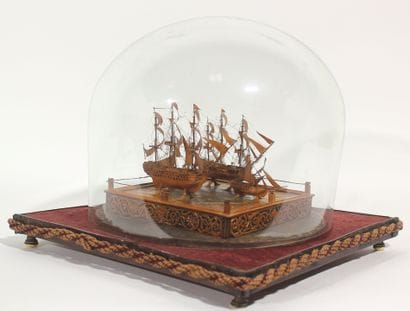
The models are presented on an "altar" with openwork sculpted sides and a base inlaid with flowers and geometric motifs. All on a period stand covered with red velvet and an inlaid black central disk.
Circa 1805/1810.
Some wear and tear, but remarkable if not exceptional condition given its age.
Presented in a 21.5 cm diameter globe.
Sold as is.
Please note: Prior registration is required to bid on this lot.
Note: In 1793, when French troops occupied Belgian lands, threatening Dutch and British trade, war was declared. A great conflict (1793/1815) ensued between England and revolutionary France (1793/1802) first and Napoleonic France (1803/1815) later. The long sea and land wars culminated in England's complete triumph as the world's predominant maritime and imperial power. At the end of these twenty-two years of war, 67,000 French prisoners were recorded in England, many of them sailors. Senior officers were sometimes paroled to villages near the coast, while others were locked up in prisons and the infamous floating pontoons (unarmed warships). In England at the time, all these prisoners had the enormous advantage of being able to improve their lives in any way they could. This concession led to the development of a sizeable production economy. Products ranged from the simplest (boxes, sewing and smoking kits, combs, brushes, etc.) to the most elaborate: pontoon models. The quality of pontoon models varies enormously from one to another, but they are all worthy of interest and respect in view of the conditions in which they were made. Their dimensions can vary, most measuring around 30 cm, while the most prestigious are over 60 cm and never much over 90 cm. The latter, extremely rare, are generally true masterpieces. Some of the smallest pontoon models are made of wood, while others are made of bone (generally ox bone), a material that was readily and cheaply available to prisoners. They are the work of teams of prisoners, some specializing in planking, others in pulleys and sheepsheads, others in sculptures and figureheads, others in ropes, others in rigging... The tools were simple and limited: knives, scrapers, reamers, etc. made, for the most part, by the prisoners themselves.
My orders
Sale information
Sales conditions
Return to catalogue