

Lot n° 71
Estimation :
20000 - 30000
EUR
Emile GALLE (1846-1904) - Lot 71
Emile GALLE (1846-1904)
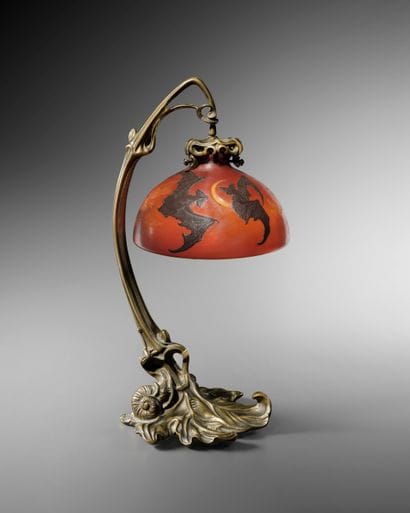
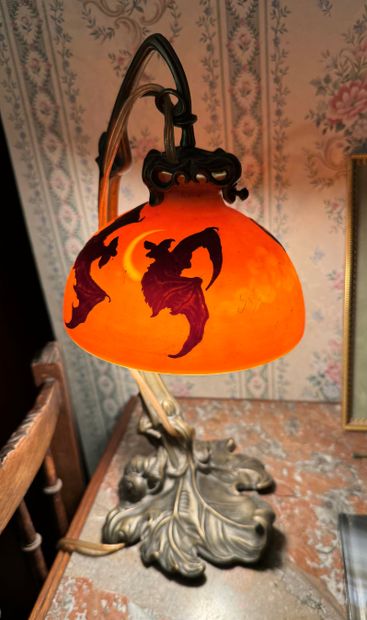
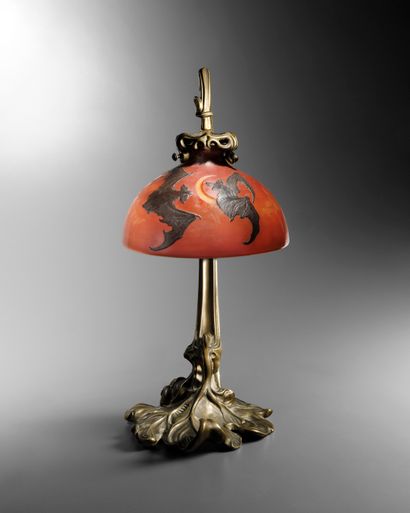
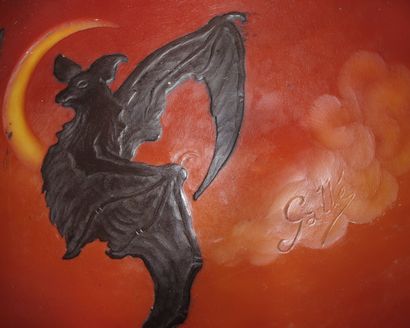
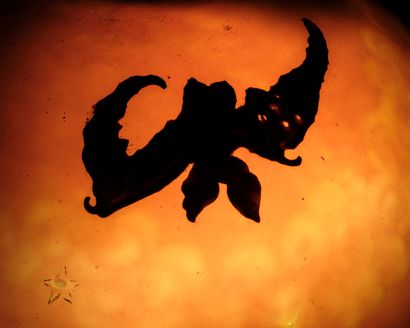
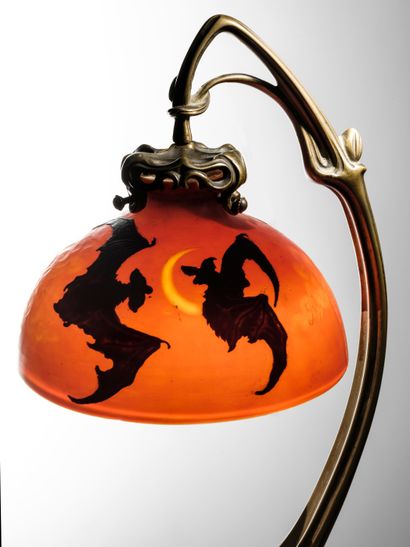
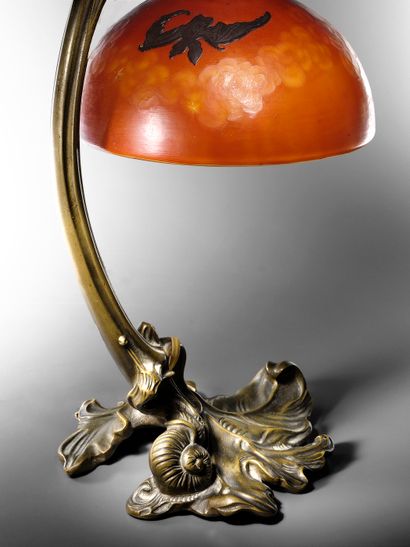
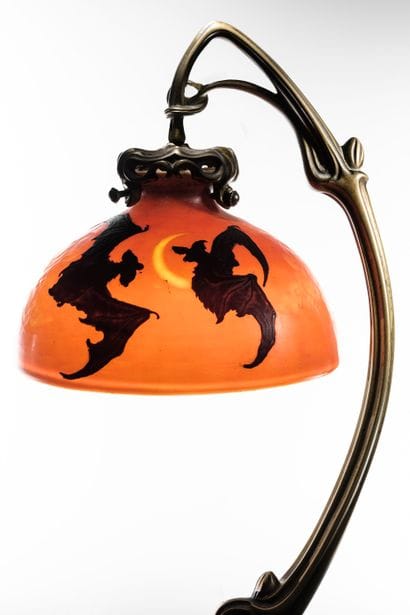
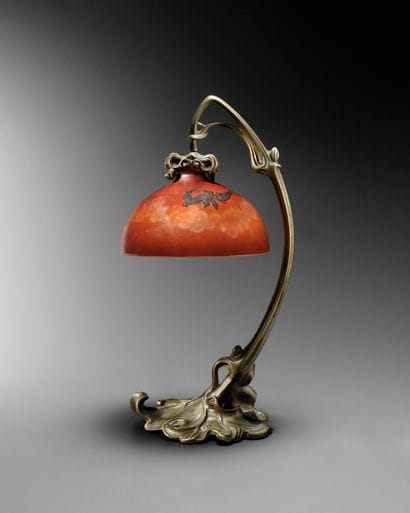
Chauve-souris au crépuscule" (Bat at dusk) lamp, c. 1902, with shaded gilded patinated bronze structure decorated with leaves and snail. Lampshade in violet-black multi-layered glass on an orange and yellow background. Three bats in flight around a wheel-cut crescent moon on a lightly hammered background with small facets forming clouds.
Signed in the decoration (one original screw missing from the shade, one screw added as reinforcement).
Height: 32 cm
Provenance: in the same family for over a century
Please note: Prior registration is required to bid on this lot.
Bibliography: - Alastair Duncan & Georges de Bartha, Glass by Gallé, Harry N. Abrams, New York, 1984, similar model referenced under n°252 and reproduced on p. 172.
- François Le Tacon, L'œuvre de verre d'Emile Gallé, Editions Messene, Paris, 1998, similar model referenced under no. 127, reproduced on p. 160 and p. 187.
- Alastair Duncan & Georges de Bartha, Gallé Lamps, Antique Collectors' Club, Woodbridge, 2014, similar model referenced and reproduced p. 32 under no. 3.14, p. 72 and 79.
On view in Paris until October 23, by appointment, with the expert Madame Amélie Marcilhac, 5 rue de Nesle, 75006 Paris - Tel. 06 71 81 38 35
BATS BY EMILE GALLE
An undisputed master glassmaker, Nancy-based Emile Gallé (1846-1904) also distinguished himself in ceramics and cabinetmaking throughout his career, enabling him to work with different materials and explore each of them in depth.
Awarded a prize as early as 1878 for his "clair-de-lune" glass, he continued to refine his technical skills and his work in the service of glass, most often creating vases or bowls that were a great success and received rave reviews at every exhibition. Much rarer are his lighting glassworks, unique models of equally remarkable technical prowess, whose transparency, enhanced by lighting, whets the appetite of collectors. The very first luminous creations appeared at the end of the 1880s with his mosque lamps, but few pieces were created. Was Emile Gallé skeptical about the technical and commercial durability of electricity? It's also possible that the faint glow produced by the first incandescent bulbs didn't convince the master glassmaker of their ability to enhance the transparency and subtlety of his creations. In 1899, he created his first electric lamp. He then presented a few lights at the Exposition Universelle in Paris in 1900, but it was not until 1902 that he really began to create numerous models, going so far as to decorate La Garenne, the family home, for the wedding of his daughter Thérèse.
His creations are marked by organic lines that combine naturalistic realism with poetic delicacy. As a meticulous botanist, he blows coprins, umbels and coloquintes into glass lamps, which become luminous sculptures in their own right in his hands, whether placed on a table or hung on a wall. Some pieces are also inspired by fauna, as illustrated by our bat model, which reveals a more symbolist and enigmatic side to his work. This animal, traditionally perceived in the West as a disturbing, even diabolical being due to its hybrid nature and nocturnal habits, became a highly prized decorative motif for artists of the period. This vogue can be explained by the rediscovery in Europe of Japanese culture, where the bat was a symbol of good fortune, and by the distribution of prints, such as those by Ohara Koson, whose pure lines emphasize the graceful silhouette of the animal against the full moon. This fascinating, dreamlike beast was then rehabilitated in a variety of forms, from the decoration of a Henri Husson goblet to the jewelry designed by René Lalique for Nathalie Clifford Barney, not forgetting Sarah Bernhardt's inkwell bust, in which the artist herself is depicted wearing chiropteran wings.
Emile Gallé was no exception to this Japanese influence and, with the help of his studio head Louis Hestaux, depicted the animal in flight through drawings and poncifs, which he then transcribed onto vases and lighting fixtures.... Amélie Marcilhac
Mes ordres d'achat
Informations sur la vente
Conditions de vente
Retourner au catalogue